


Cervical osteochondrosis is a change in the plates of the cervical vertebrae, as a result of which they undergo degenerative-dystrophic changes.The main reason for its formation is the disruption of the normal course of metabolic processes, which leads to distortion of the structure of the vertebral bodies and discs.In the case of localization in the neck, the symptoms of the pathology are largely determined by the compression of large blood vessels.Treatment methods are selected depending on the stage, specific course, severity and main symptoms.
Characteristics of the disease
The cervical form is the most dangerous type of osteochondrosis: it leads to deterioration of cerebral circulation, since the vertebral artery, one of the largest vessels that supplies the brain with the necessary substances and oxygen, passes through this area.
Displacement of the vertebrae, pathological changes and the proliferation of bone and fibrous tissue disrupt the normal functioning of the blood vessel.
In this section, the specificity of the symptoms of osteochondrosis is determined, among other things, by one of the structural features of the cervical vertebrae, which consists of a closer fit to each other.As a result, any change in one segment causes disruption throughout the department.
Depending on the clinical stage
During its development, cervical osteochondrosis goes through four stages.How does it manifest itself in each?
- Section 1.It is characterized by initial disturbances in the stability of the intervertebral discs.Symptoms are mild or absent.Mild pain and local muscle tension are possible.
- Section 2.Disc protrusion begins, the gaps between the vertebrae decrease, and the fibrous ring is destroyed.In many cases, pain occurs due to the compression of nerve endings, mainly of a point type.They become stronger when turning or tilting the neck.The voice decreases, weakness often appears.
- Section 3.The process of final destruction of the annulus fibrosus leads to the formation of hernias.This stage is characterized by significant deformation of the spine.Increased pain and fatigue appear against the background of sensory disturbances and limited mobility in the affected area.
- Stage 4 is the most severe.Intense pain occurs with every attempt to move, which significantly limits the mobility of the ward.Sometimes the pain subsides, but this does not indicate an improvement in the condition, it only indicates an increase in the size of bone growths, which significantly limits movement.They often lead to the patient's disability.
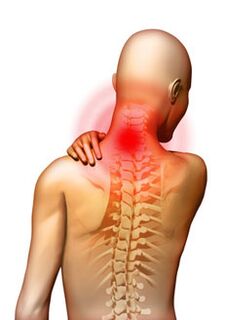
Symptoms of cervical osteochondrosis
If it is located in the cervical spine, the typical symptoms of osteochondrosis are:
- pain in the neck, back of the head, shoulders, arms;
- restriction of movements, crunching at different turns, tilting of the neck;
- weakness in the arms;
- stabbing pain in the left side of the chest, radiating to the right arm;
- burning in the interscapular area;
- recurrent headache;
- weakness;
- dizziness (in severe cases of cervical osteochondrosis can reach unconsciousness);
- the coordination of movements is impaired, which is primarily manifested in walking;
- hearing loss, tinnitus;
- reduced vision;
- sore throat;
- poor dental condition;
- weakening or hoarseness of the voice;
- snoring is the result of tension in the neck muscles.
In the cervicothoracic type, the symptoms are almost similar to the symptoms of cervical osteochondrosis.These are:
- asthenic syndrome;
- dizziness and headache;
- periodic pressure fluctuations;
- flashes of flies before the eyes;
- pain in the shoulder girdle and arms;
- muscle weakness;
- numbness, tingling, chills in the fingers;
- pain in the chest, in the area of the heart;
- nausea;
- numbness of the tongue, face;
- dental problems;
- sensation of current running along the arms when trying to bend the neck.
syndromes
The symptoms of cervical osteochondrosis cannot be considered typical.Which one is the most pronounced depends largely on the specific target of the lesion.Many manifestations can be mistakenly associated with other pathological conditions.Therefore, there are often cases where the wrong treatment is prescribed.
The symptom complex is divided into the following groups:
- radicular;
- vertebral artery syndrome;
- irritative-reflex syndrome.
Radicular syndrome
Another name is cervical radiculitis.The syndrome develops as a result of pinching of nerve endings in the neck region.The pain spreads from the neck down, into the shoulder blades, along the shoulder along the outer side of the forearm to the fingers.In this case, the following often appear:
- "goosebumps" feeling;
- tingling in the hands, forearms, fingers;
- stickiness.
Manifestations also vary depending on the affected area.If the central nerve endings are affected, the pulpiness spreads to the thumb, middle and index fingers.When the brachial nerve endings are pinched, the little finger and the ring finger are affected.
Irritative-reflex syndrome
Its symptom is a burning, sharp pain in the neck-occipital region, which occurs after a static state during movement: after sleeping, sneezing or turning the head sharply.The pain often radiates to the shoulder and chest.
Vertebral artery syndrome
Symptoms of cervical osteochondrosis are as follows:
- throbbing or burning headache (paroxysmal or persistent), spreading to the temporal region, the top of the head, the back of the head, the brow ridges;
- increased discomfort during certain movements or after staying in an uncomfortable position for a long time;
- general weakness;
- nausea;
- loss of consciousness;
- hearing problems;
- dysfunction of the vestibular apparatus;
- eye pain;
- blurred vision.
Cardiac syndrome
When the symptom complex of cervical osteochondrosis appears, a picture almost similar to angina pectoris develops, which often leads to incorrect treatment.
Muscle contractions and spasms occurring in the area of the heart are most likely reflex reactions to the compression of nerve endings in the lower neck region.Cardiac syndrome is the result of irritation of the phrenic nerve (its fibers lead to the pericardium) or the pectoralis major muscle:
- the pain appears suddenly and lasts for a long time;
- aggravated by sudden movement of the neck, coughing, sneezing;
- tachycardia and extrasystole are possible;
- the pain does not improve after taking coronary vasodilators;
- there is no sign of circulatory disturbance on the EKG.
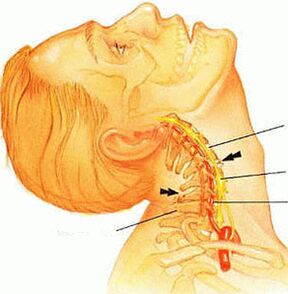
Aggravation of the disease
In the acute stage, the symptoms of cervical osteochondrosis are as follows:
- increased pain and its radiation to the shoulder blades, interscapular area, arms, shoulders;
- difficulty moving the shoulders, trunk, arms, and sometimes breathing (breathing in and out);
- the pain syndrome often resembles a heart attack or intercostal neuralgia;
- when pain appears in the right hypochondrium or iliac zone, the clinical picture is similar to the manifestations of gastritis or cholecystitis;
- the headache is long-lasting, disturbances in balance, visual and hearing functions occur;
- in the innervation zone, skin trophism is interrupted, tingling, numbness, dryness, pallor, burning and chills appear;
- the tone of the neck muscles increases;
- weakness, lethargy, nervous tension, anxiety, emotional instability appear;
- Sleep disturbances, memory disturbances and concentration difficulties may occur.
Osteochondrosis and vegetative-vascular dystonia
Cervical osteochondrosis can lead to subluxation of the first cervical vertebra, shifting to the right or left, which provokes the development of VSD (vegetative-vascular dystonia).It is quite difficult to identify as there are often no symptoms or they are mild.In this case it is possible to:
- compression of sympathetic nerve plexuses leading to neurological symptoms or VSD;
- compression of arteries and deterioration of cerebral circulation;
- compression of the veins, which causes a violation of the outflow of blood and a subsequent jump in intracranial pressure;
- compression of the spinal cord, which causes impaired movement of cerebrospinal fluid, which also results in high intracranial pressure;
- muscle spasm, which increases symptoms due to severe compression of blood vessels and nerves.
The result of the described processes:
- headache;
- darkening of the eyes;
- dizziness;
- impaired visual acuity;
- double vision (diplopia);
- "flies" flash before the eyes;
- high or low blood pressure;
- nausea, sometimes with vomiting;
- loss of consciousness.
Vertebral subluxation is detected using X-rays.Its reduction is a rather complex procedure, usually performed under general anesthesia.
How is the disease diagnosed?
The leading methods of diagnosing cervical osteochondrosis are:
- radiography;
- magnetic resonance imaging;
- computed tomography;
- Doppler ultrasound;
- double-sided scanning.
The last two methods are used to check the condition of the neck veins.